Outline
Accountants have to ID verify Directors and Persons of Significant Control before submitting company formation filings to Companies House to comply with the upcoming Economic Crime and Corporate Transparency Act 2023.
Formation flow
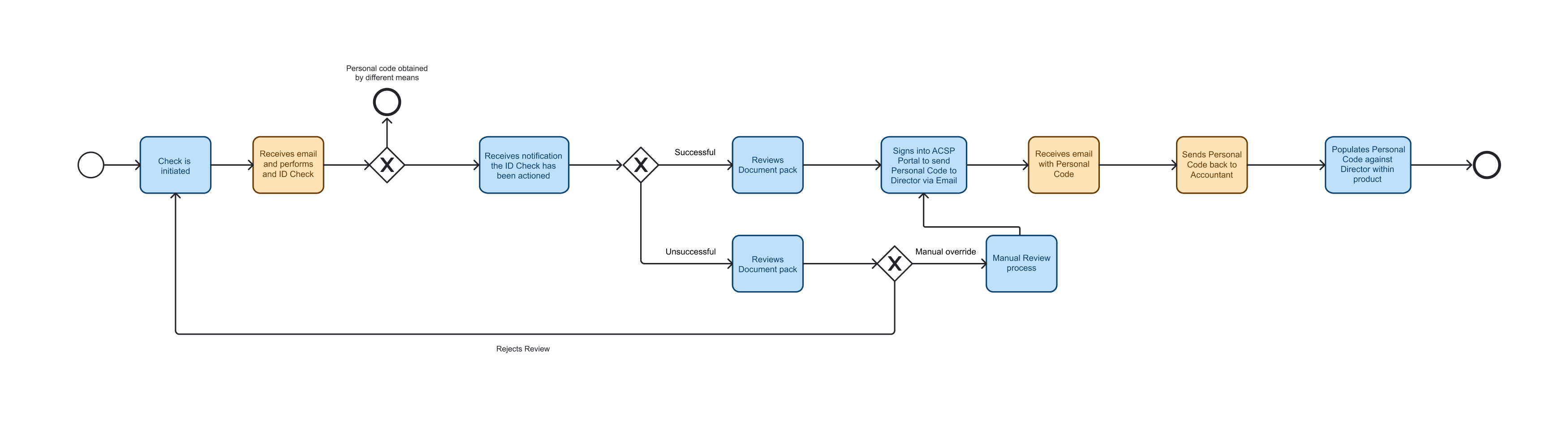
To kick the design off, I collaborated with the InformDirect team, a team that specialise in Companies House submissions as a service. Leveraging their knowledge and expertises and we mapped out and agreed the entire formation flow, start to finish to help shape what BrightChecks needed to actually do.
Research
I planned and conducted numerous 1:1 interviews with accountants to understand how might they plan to comply with the ECCTA requirements and what their workflow would look like without a dedicated product.
Key insights
- Status tracking happened on a shared spreadsheet, updated manually by whoever last heard from the client.
- There was no automated notification when a client completed verification, and no single reliable source of truth for compliance status.
- Accountants could send a request without friction, but there were delays with clients either not receiving a check notification or not understanding the requirements.
- Accountants also expressed there was an issue with checks not being actioned, this caused sticking points in their workflow and billable time.
- They didn't want another product, they wanted it baked into existing workflows.
Problem definition
Discovery confirmed the problem was not so much a technical limitation. Identity verification technology already exists. The problem was ownership and visibility at firm level, and needed to unstanding how might we:
- Give accountants real-time visibility into verification status across all active formations?
- Embed check initiation in the existing formation workflow so accountants encounter it in context rather than as a separate task?
- Design a client experience that guides unfamiliar users through a sensitive process with minimal friction and maximum clarity?
- Treat an audit trail as a requirement as a primary feature, and not a compliance checkbox?
Design principles
Bright chose Credas as their third-party verification provider, and using a third-party provider the user experience had some limitations that needed to be accounted for:
- Integrated, not bolted on. Verification needed to feel like a natural part of the formation workflow. Check initiation is embedded in the existing client record, not separated into a standalone product.
- Compliance as a first-class feature. The audit trail, timestamped records, and exportable evidence are not buried in settings they are primary views accessible from every check record.
- Reduce the bottleneck. Research identified client completion as the real hold-up. Accountants needs a clear view to see the state of a check with the option to re-send or override.
Designs
Dashboard
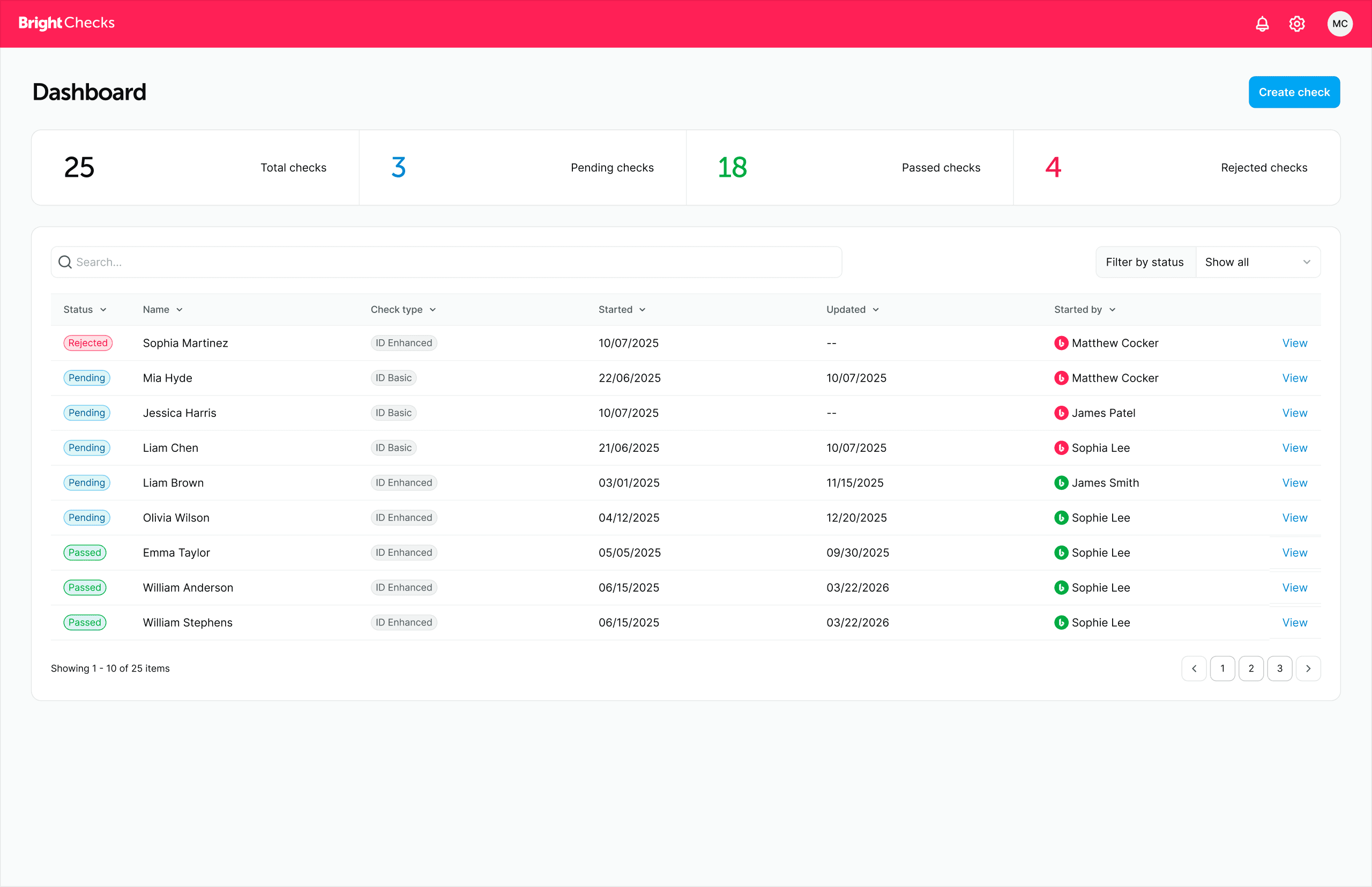
The dashboard gives accountants a single view of all active and completed verifications, filterable by status, type, and client. The design prioritises scannability colour-coded status indicators let a manager assess portfolio-wide compliance at a glance without reading each row in detail.
Starting a check
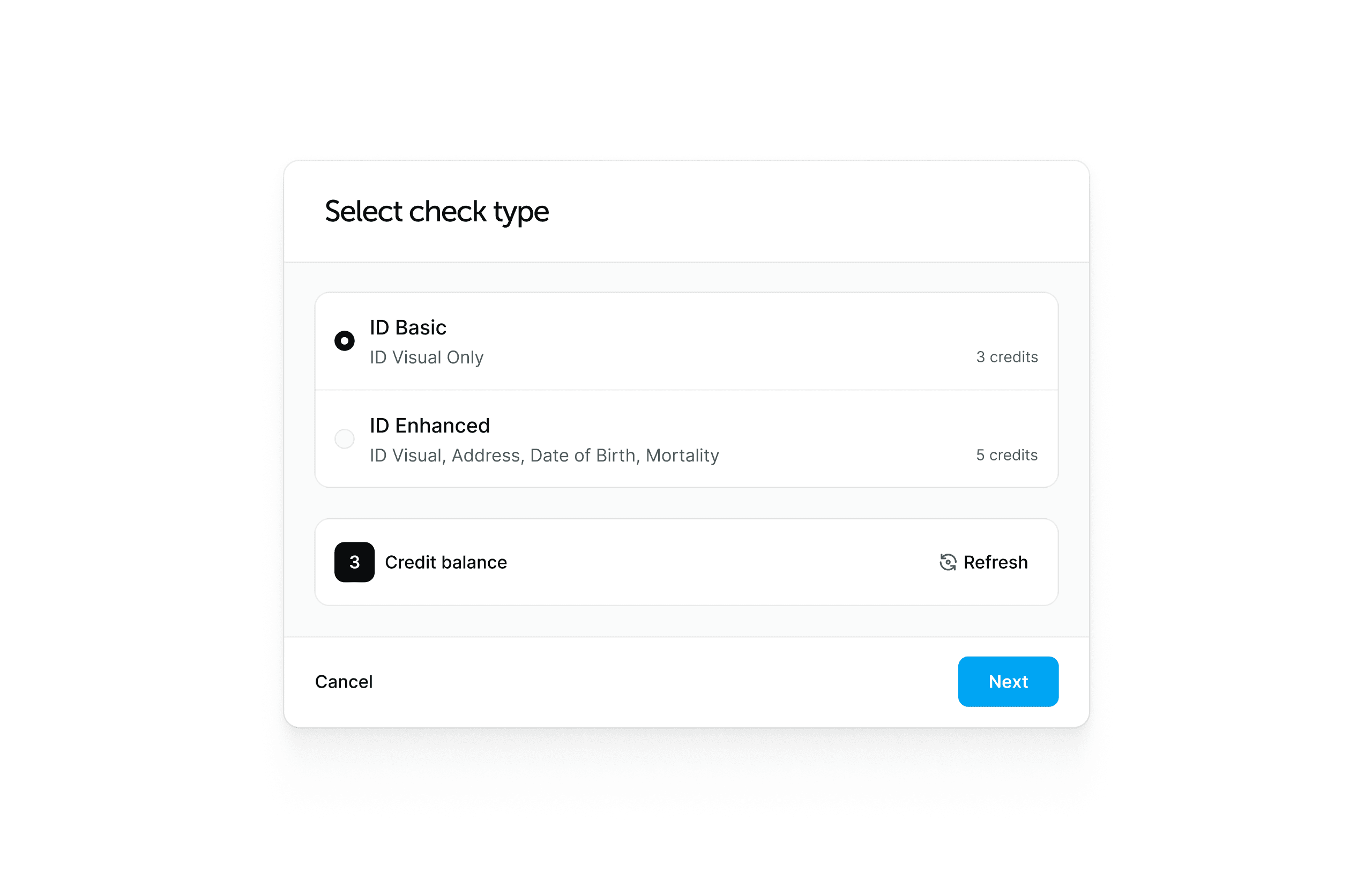
Check initiation is triggered from the client record within the formation workflow. Pre-filled information reduces manual input; clear prompts explain what the client will receive and what happens next. The goal was to make the accountant's part of the process feel like a single action in context, not a separate form to complete.
Check details & audit trail
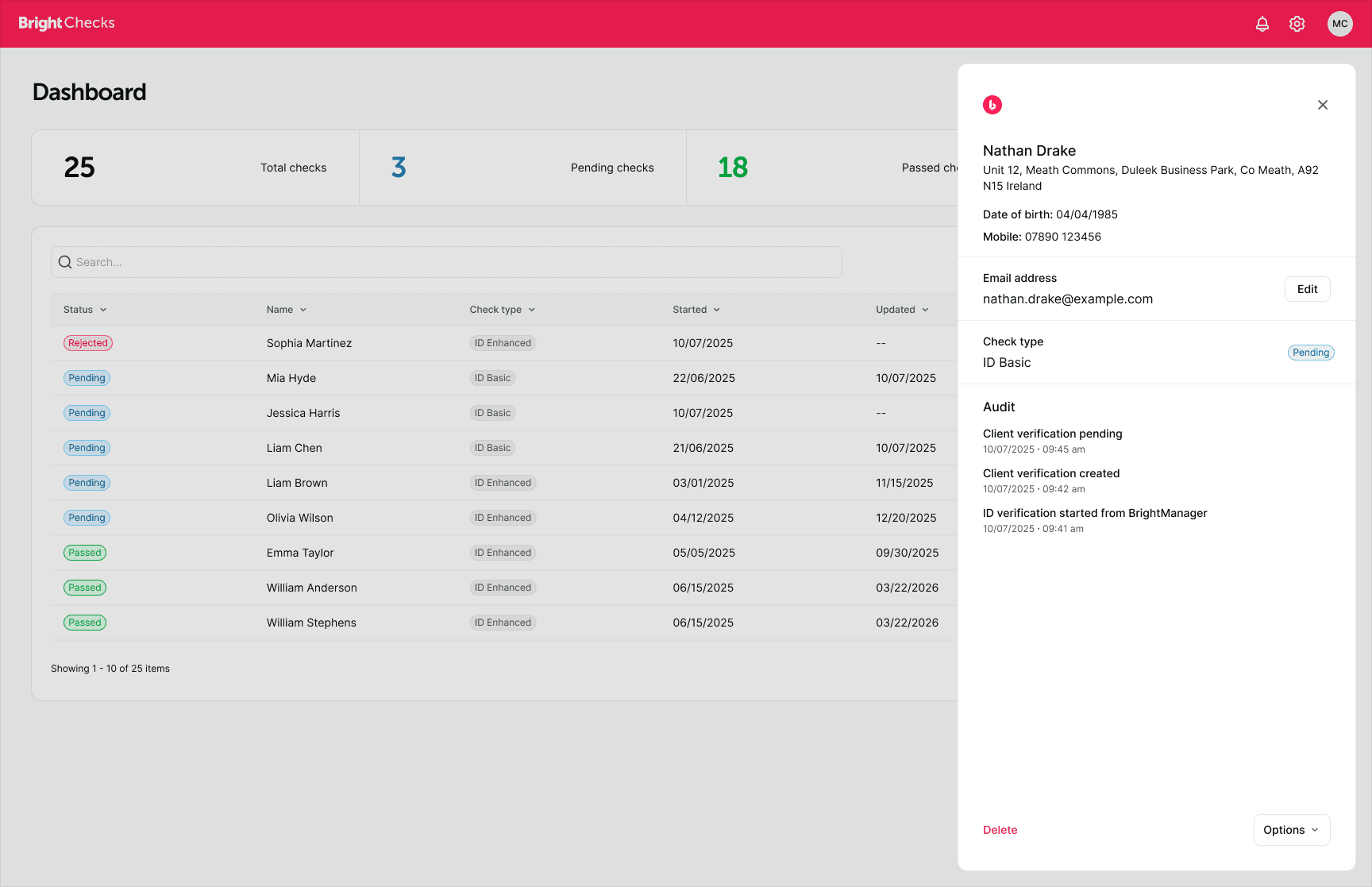
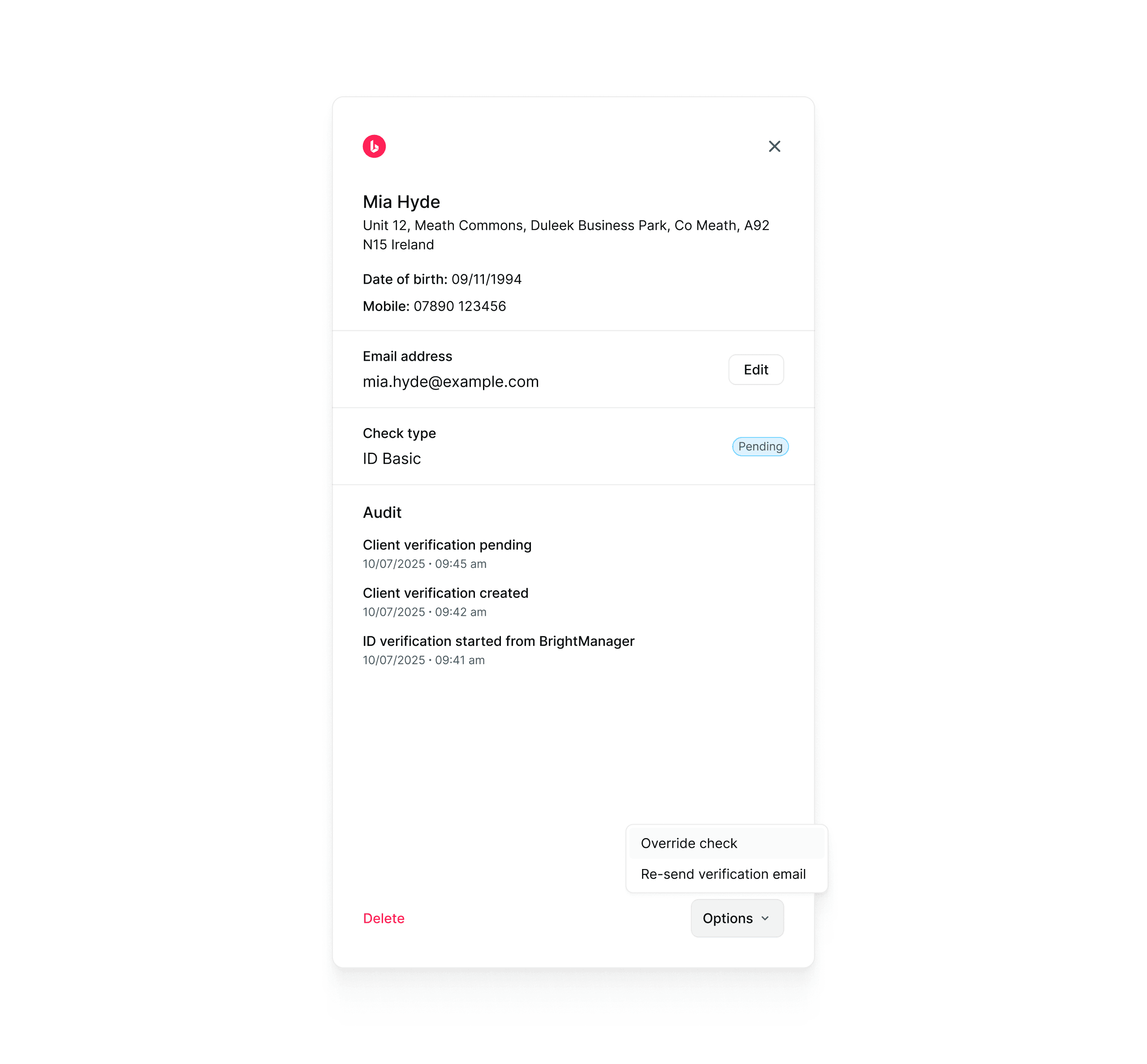
After initiating a check, accountants can drill into the record for the full picture. To keep context, I opted for a fly-out drawer component to give the accountant a snapshot of the check.
It housed the following: which Bright product the check was started from, the Directors/PSCs personal information, the check status and the audit trial. It also housed a button group so an accountant could trigger an event to 'delete a check', 'override or resend a check' or 'download a document pack'.
The audit trail is immutable. Once an event is recorded, it cannot be edited or deleted. This is a regulatory requirement, and the design reflects it explicitly rather than abstracting it away.
Manual overrides
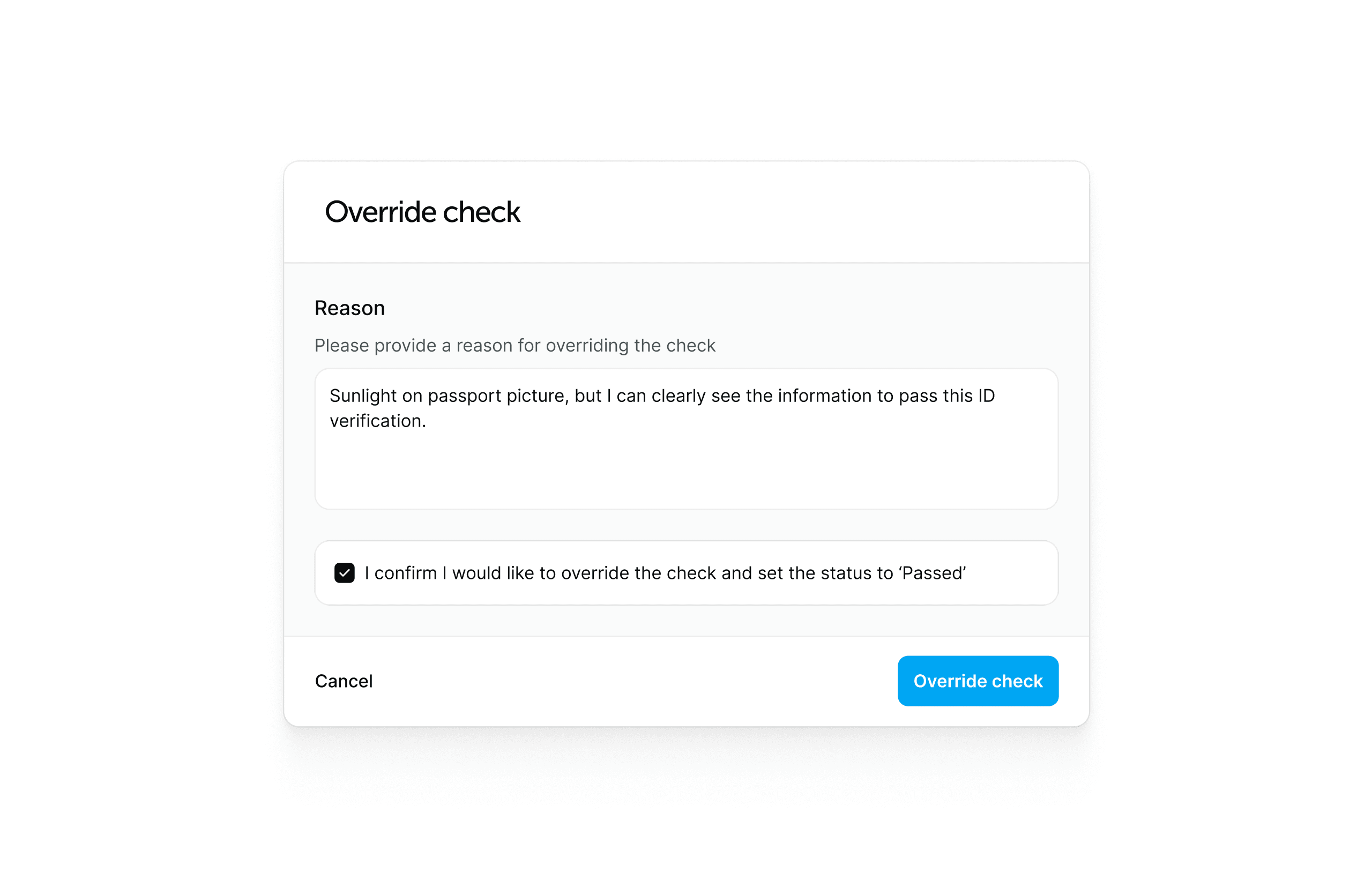
Failed verifications require a defined escalation path. The design provides a standard referral flow the accountant is notified, the check is flagged, and any manual override decisions are actioned and recorded in the audit trail with attribution. This keeps the compliance record intact even when the outcome is not a clean pass.
Deleting a check
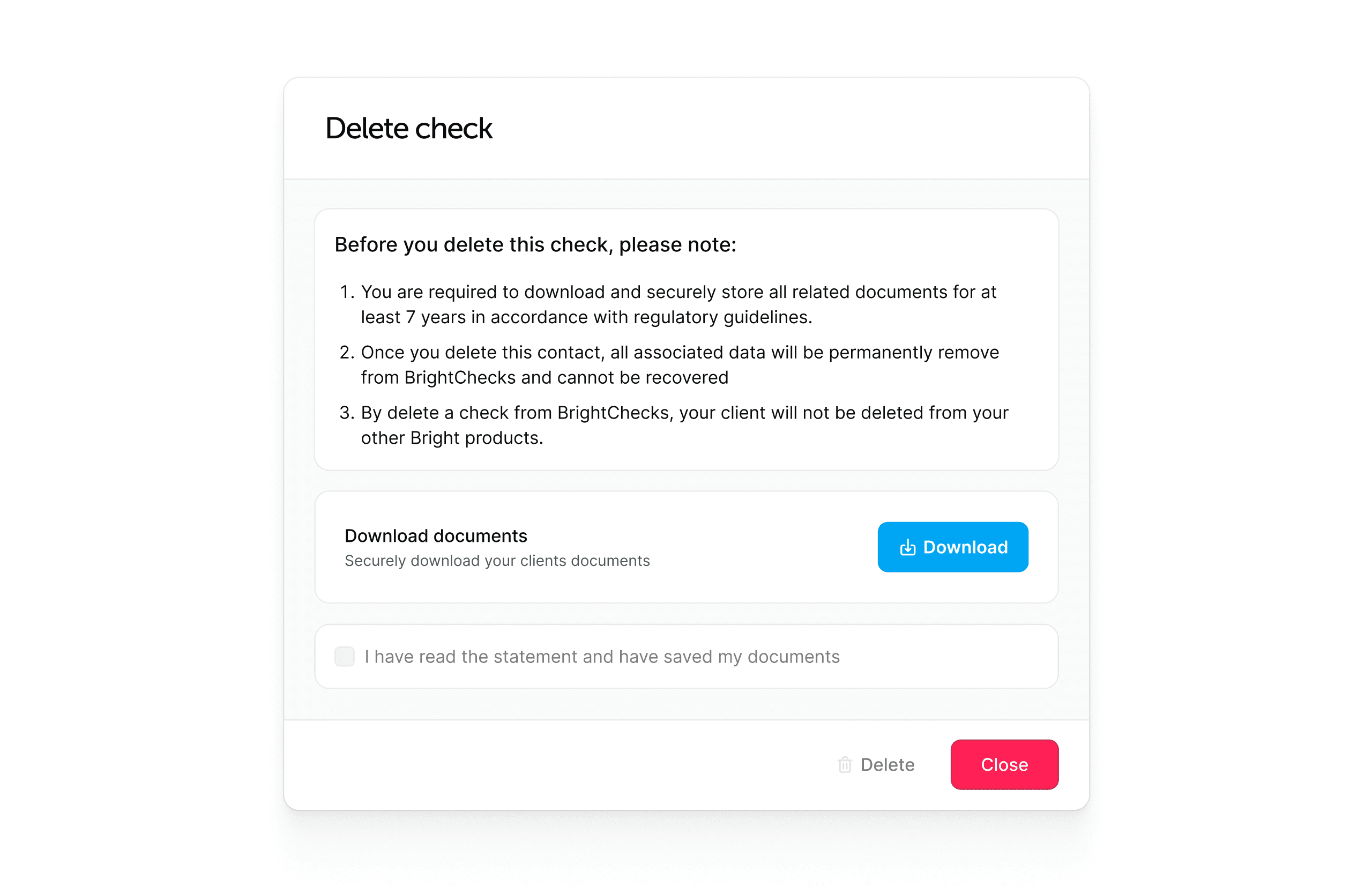
ECCTA requires firms to retain verification evidence for up to seven years. Deleting a check triggers a confirmation flow that makes this obligation explicit, prompting the accountant to export and securely store all associated documentation before proceeding.
Outcomes
BrightChecks shipped as an integrated feature within Bright's product portfolio, available to accounting practices managing company formation filings for the ECCTA.
Impact
- Faster verification turnaround compared to the GOV.UK One Login route
- Reduced administrative overhead for accountants handling multiple formations simultaneously
- No additional training required for adoption the integration, users found the solutions easy to use
Reflection
Mapping the full formation flow across all users before touching screens was worth more than expected. It surfaced the delete flow, the failed-check escalation, and the Credas handoff points early, and gave the team a shared reference.
Third-party integrations deserve mapping before design begins. Early wireframes that ignored which Credas steps were fixed had to be reworked once engineering scoped the integration. Treating the fixed points as structural from the start would have saved that rework.